
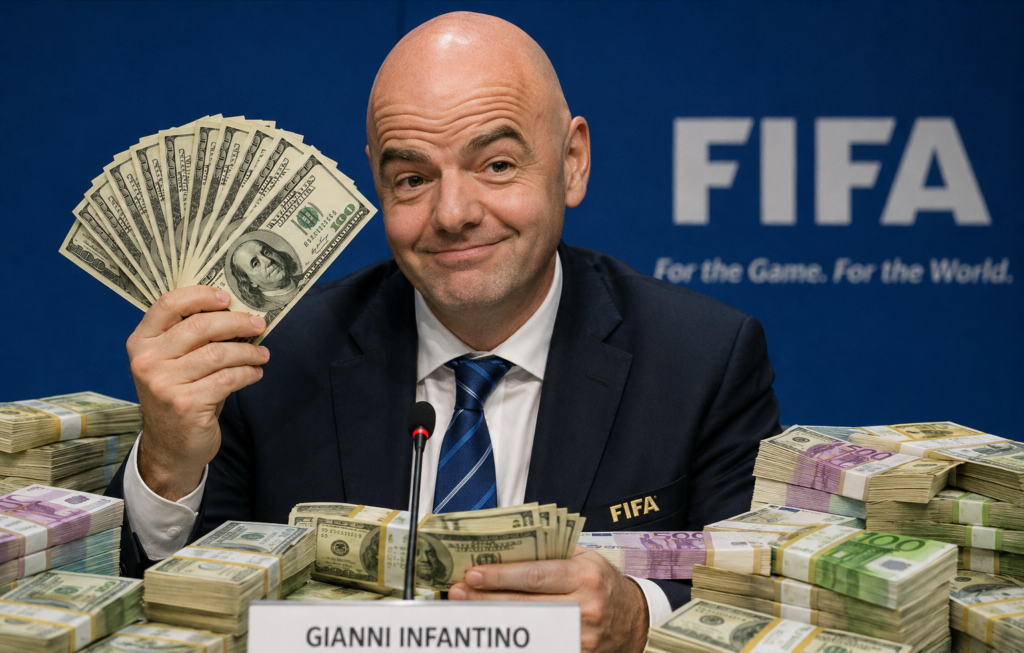
FIFA, the world soccer governing body, is expanding its tournaments. The sports organization solves problems with money – but this time, it’s coming up short.
Once again, the soccer world has taken issue with FIFA, its governing body.
Under the leadership of President Gianni Infantino, the Zurich-based sports organization presented a plan to open up parts of the World Cup to external investors.
The Press as a Spoilsport
Even before the details were made public, bits and pieces of information had already been picked apart in the media.
The backlash from the Union of European Football Associations (UEFA) was particularly fierce, with the organization threatening to boycott the World Cup should the plans be implemented.
On Friday, FIFA President Infantino then addressed the global public and presented the exact details of the plan.
He criticized the media, saying that “fake news” would otherwise derail the proposal.
From 32 to 48 to 64
After the FIFA president achieved a spectacular financial success with the recently concluded World Cup in Canada, Mexico, and the U.S., FIFA now wants to further optimize the model.
This time, 48 teams competed instead of the usual 32, which led to a doubling of revenue to 15 billion dollars.
In the future, as many as 64 teams are expected to participate in the tournament.
20-Percent Stake Brings 4 Billion
The organization and staging of these very games would be outsourced to a company, FIFA Forward Enterprise (FFE), as Infantino explained in a video message.
The U.S. bank J.P. Morgan conducted a valuation of the company and estimated its value at around 20 billion dollars.
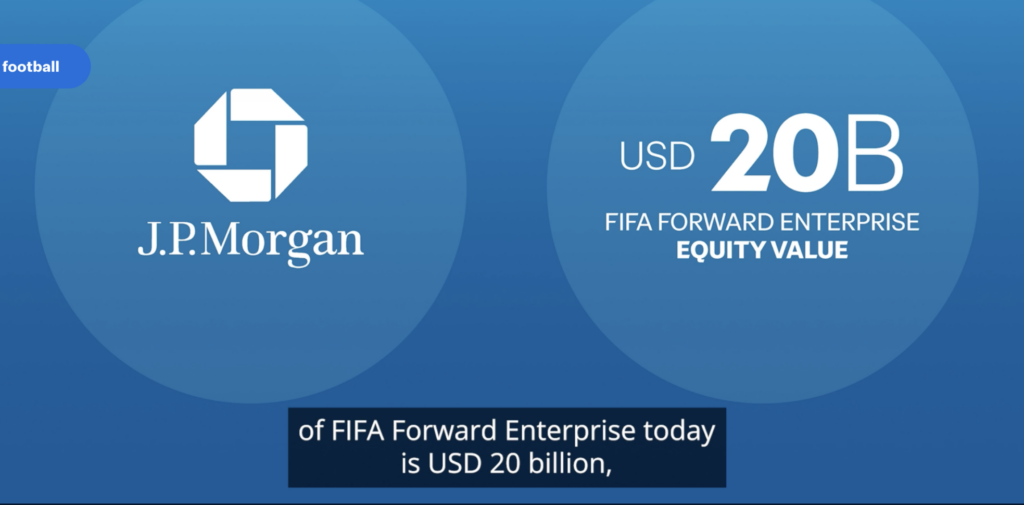
FIFA is now considering selling 20 percent of that to long-term investors, which would bring in about 4 billion dollars to the association’s coffers.
A windfall from Zurich
Infantino emphasized that FIFA would retain an 80 percent stake in the FFE and thus maintain control over soccer competitions.
It was stated that governance and FIFA rules would not be affected by this change anyway.
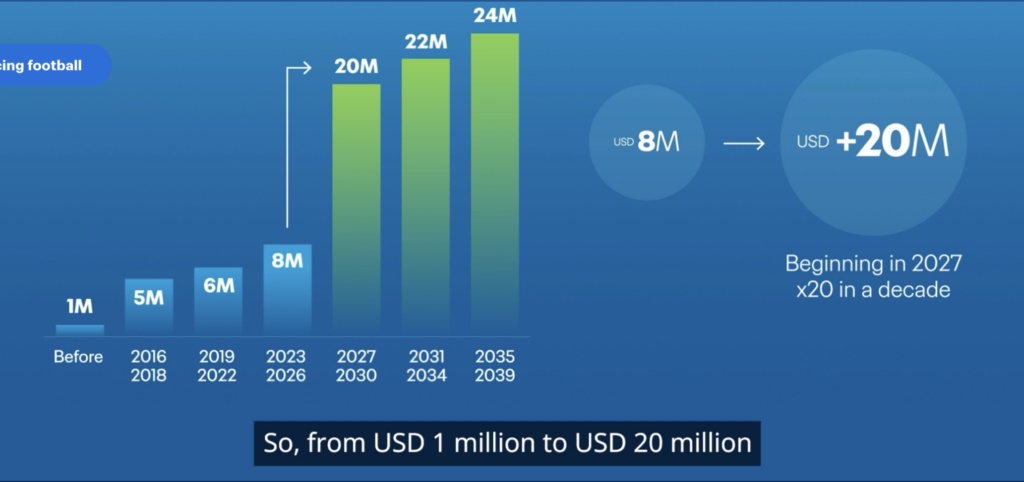
The money would, in any case, go entirely toward promoting soccer around the world.
This situation once again demonstrated how FIFA has always solved problems. Infantino promised each of the 211 member associations 20 million dollars per year, up from the previous 8 million dollars.
This likely made it easy – especially for poorer soccer nations – to agree to the outsourcing of FIFA games.
Controlling the Goals
FIFA’s 20-percent stake in the organization and marketing of the World Cup is essentially ‘dead capital’ for the organization – which is why selling it to outside parties is definitely worthwhile.
This model simply allows all expected future profits to be monetized today.
With an 80 percent stake, Infantino & Co. continue to hold the reins. The Valais native may even want to take the CEO position at the FFE himself.
Further monetization using debt – that is, leverage – makes perfect sense if the goal is to take soccer promotion to the next level.
Half-Hearted Backtracking
The uproar, however, is anything but surprising, because the plans had been virtually secret until now and are now spooking the entire world.
Yet the proposal would certainly have been approved by both FIFA and its member organizations had FIFA not backtracked late Friday night.
The plan will not be pursued further, FIFA announced in a brief statement.
According to FIFA, the countries that needed the most support will now, unfortunately, be left empty-handed.
July 31, 2026/kut./ena./report updated and expanded