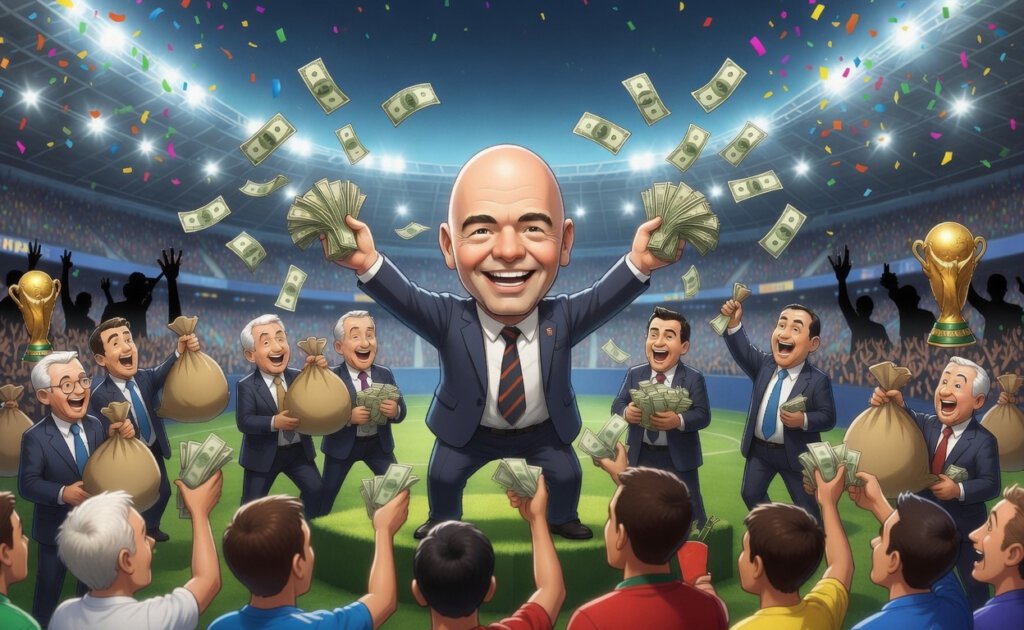
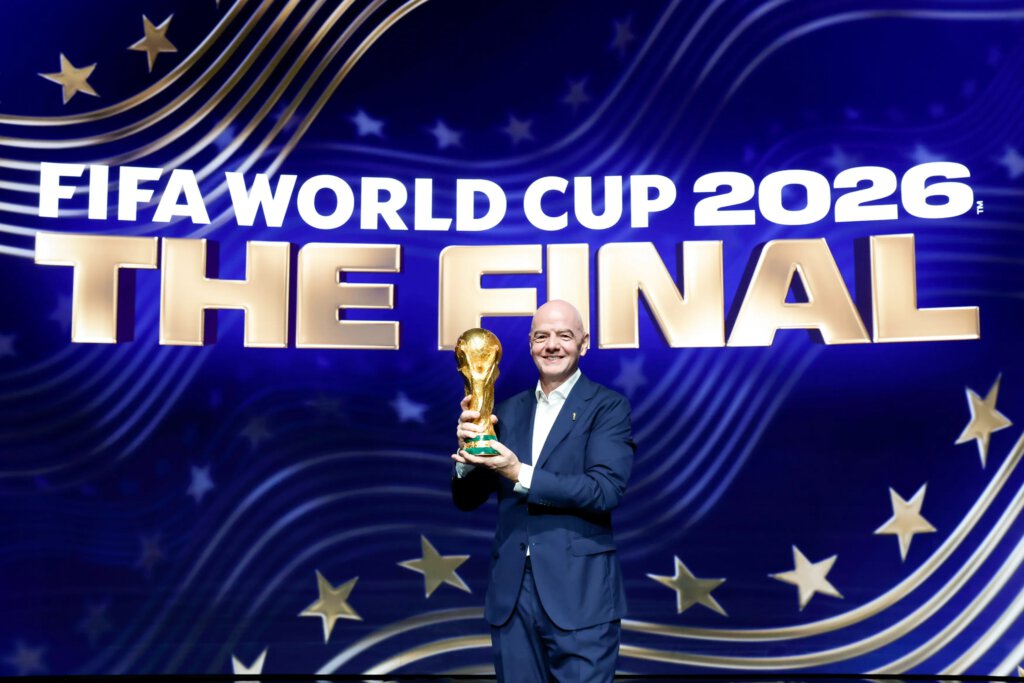
Spain has won the 2026 World Cup. Now, billions from FIFA, the world soccer governing body, are flowing across the globe.
The 2026 World Cup came to an end early Monday morning.
In the final, Spain faced Argentina and secured a well-deserved victory over the South American team led by star soccer player Lionel Messi.
75 Percent in Additional Revenue
Now the billions are flowing. With the expanded 48-team World Cup, FIFA took in about 15 billion dollars, as FIFA President Gianni Infantino announced shortly before the final match.
In the previous four-year cycle, which included the World Cup in Qatar with 32 teams, the world soccer governing body had earned “only” about half that amount – 7.57 billion dollars.
Even so, revenue had already risen by 18 percent compared to the previous cycle from 2015 to 2018.
355 million for the tournament
The soccer spectacle in Mexico, Canada, and the U.S. was thus a huge commercial success. This generated revenue from advertising, ticket sales, and licensing fees. Of the approximately 15 billion dollars, 95 to 99 percent will be reinvested in soccer.
This allowed the World Soccer Federation to justify the high ticket prices, as the money would not go to middlemen but would instead flow back into the sport.
The FIFA Council had confirmed in advance that a fund of 355 million dollars would be set aside for the World Cup. That was about 70 percent more than in 2022.
Thousands for the Players
A total of 100 million dollars was set aside for clubs that provided players for World Cup qualifying matches. This will be distributed on a per-player, per-game basis.
With 905 qualifying matches played, the expected compensation amounted to approximately 2,360 dollars per player per game.
FIFA had announced that an additional 250 million dollars would be distributed among the clubs whose players participated in the World Cup finals.
Expected minimum compensation is 5,000 dollars per player per day. Although the final figures will not be confirmed until after the tournament, FIFA said.
The remaining 5 million dollars is set aside as a reserve. The rest will be used for FIFA programs to promote soccer.
So there’s a massive windfall of money worldwide for youth development, new stadiums, and additional soccer competitions. The term “development” is somewhat elastic in this context.
Cash for Qualification
FIFA reported that 871 million dollars is already being distributed to soccer clubs. This is already about 15 percent more than originally planned.
As a result, the World Cup participation fee rose from 1.5 million to 2 million millionen per team. For World Cup qualification, the prize money is 10 million dollars instead of 9 million dollars.
And each team receives 16 million dollars for organizing the World Cup in North America and for ticket subsidies.
The referees are also being handsomely compensated. And FIFA officials are sure to receive a bonus or two as well.
Economic Boost for the Regions
But it’s not just FIFA and the global soccer community that have benefited from the World Cup.
The organizers had also calculated the economic impact based on an analysis for Boston. The seven World Cup matches played in front of approximately 450,000 fans at the Boston stadium provided an economic boost for the region.
As a result, the hotel industry in the greater Boston area posted strong results during the World Cup, as evidenced by the figures for June.
Average Price Rose 20 Percent
For the period from June 12 to 27, the average daily rate (ADR) was 410.44 dollars, and revenue per available room (RevPAR) was 357.36 dollars per night.
These figures were each about 20 percent higher than in the corresponding period of 2025.
The economic impact extended far beyond the city limits: Across the entire state of Massachusetts, RevPAR rose by 13.3 percent compared to the previous year, according to an analysis released by FIFA.
More Money During Tournaments
On match days, the results in Boston were even more impressive.
ADR totaled 445.45 dollars, around 26.8 percent higher than in 2025, while RevPAR amounted to 405.50 dollars, representing a 28.3 percent increase compared to the same period the previous year.
Celebrations Ring Up Sales
All in all, many bars and restaurants in Switzerland that hosted public viewings also benefited from the 2026 World Cup.
And throughout the night leading into Monday, Spain was celebrated as the new soccer world champion – from Madrid to Barcelona to Basel, Zurich, Geneva, and beyond.
In the process, a lot of money also flowed into other cash registers that had practically nothing to do with FIFA.
Focus on Three Continents
And the next World Cup in 2030 is set to be even more spectacular.
It will take place on three continents. The host countries are Uruguay, Argentina, and Paraguay in South America; Morocco in Africa; and Spain and Portugal in Europe.
It will be the last World Cup to feature soccer stickers from the Italian company Panini. FIFA had ended its partnership with Panini, which had been in place since 1970, and handed the contract over to the U.S. manufacturer Topps, effective in 2031.
As FIFA President Infantino has already suggested, it’s possible that 64 teams – rather than just 48 – will compete against each other.
That would not only generate more collectible cards but also bring in even more billions overall.
July 20, 2026/kut./ena.