
Only four cantons truly shape the Swiss economy. Private sector activity plays a key role, and the global soccer federation FIFA has a noticeable impact.
The cantons’ contributions to the Swiss economy vary considerably.
It is noteworthy that the four cantons of Zurich, Bern, Vaud, and Geneva together generate nearly half of Switzerland’s gross domestic product (GDP).
Basel and Lucerne only in the middle
The Zurich Cantonal Bank (ZKB) announced this today, Monday, in a new analysis.
The 11 largest of the 26 cantons together accounted for 80 percent of GDP, while the remaining 15 cantons contributed only 20 percent to the national total.
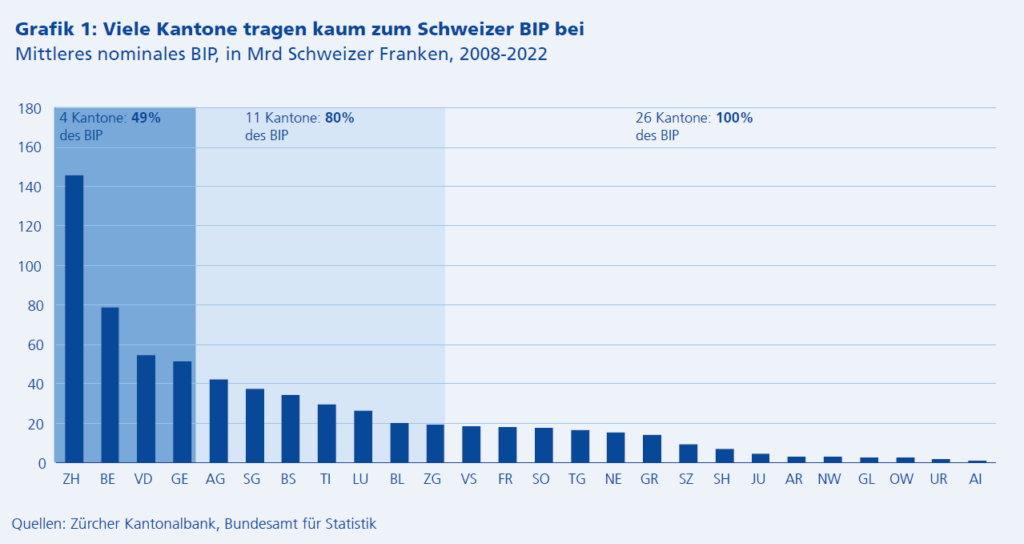
Looking at the chart, it is striking that even Basel-Stadt, with its giant pharmaceutical industry centered around Roche, Novartis, Sandoz & Co., ranks only 7th.
Lucerne has been overtaken by Ticino, painting a completely different picture of Central Swiss companies such as the dairy processor Emmi or the elevator manufacturer Schindler.
16 percent higher GDP per capita
At the cantonal level, Zurich generates 21 percent of Switzerland’s total economic output and value added.
Value added per hour worked was 5 percent above the Swiss average.
Per capita GDP in Zurich, at 104,000 Swiss francs, was also about 16 percent above the Swiss average of 90,000 Swiss francs.
According to the ZKB, the canton on the Limmat has an above-average tertiary sector, which alone accounts for nearly a quarter of Switzerland’s total economic output in the service sector.
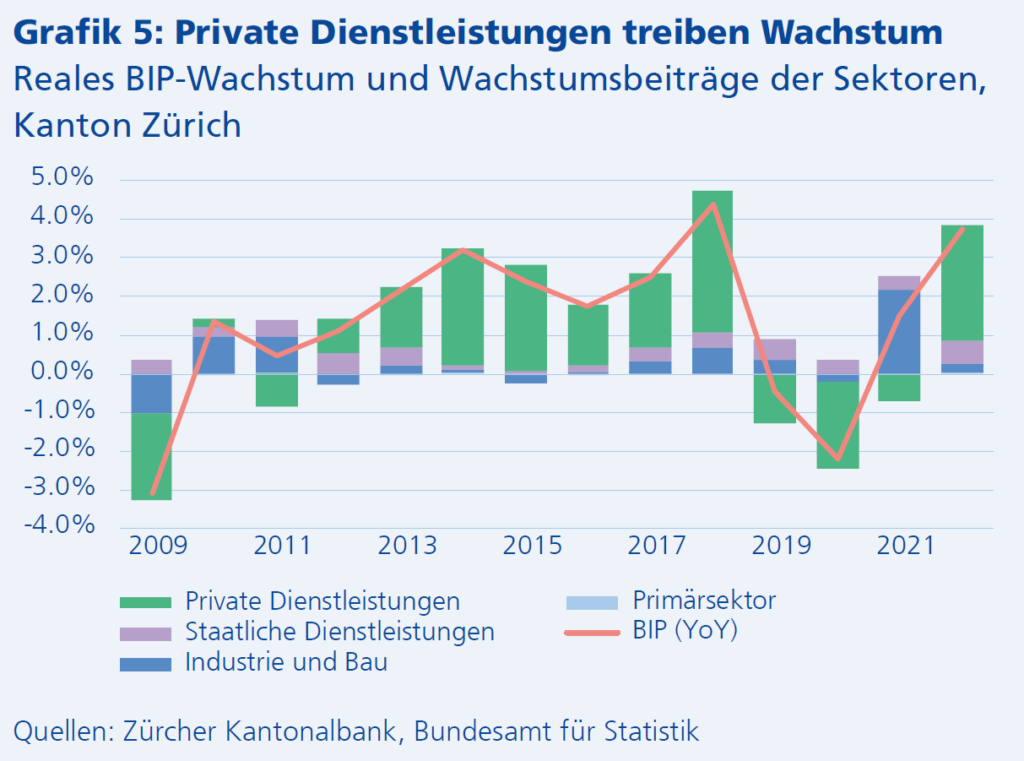
It also noted that the service industries contribute the most to Zurich’s GDP growth. This includes financial services provided by banks such as UBS, ZKB, and others.
Private Sector in the Forefront
The state-run service sectors, accounting for around 15 percent of GDP, generally make only a small contribution to growth, the state bank noted.
Private services, accounting for around 70 percent of local GDP, are the key driver of Zurich’s growth, the ZKB added.
However, Zurich’s average growth between 2008 and 2022, at 1.3 percent, was lower than that of Switzerland as a whole, which stood at 1.7 percent.
Due to its economic structure, the service sector is overrepresented in Zurich, and the labor-intensive service sector typically has lower growth rates than the industrial sector, concluded the state bank’s experts.
A Boom Every Four Years
In Zurich, however, there is an additional fluctuation effect.
FIFA, the world soccer federation, has its headquarters in Zurich, and as a result, the organization generates significant revenue every four years through the sale of broadcasting and branding rights for the World Cup.
For the Canton of Zurich, this revenue leads to fluctuations in GDP.
Specifically, the Men’s World Cup asymmetrically influences Zurich’s GDP growth rate every four years.
In a rough calculation, the sports event effect in Zurich accounts for between 0.7 and 1 percentage points – thanks to FIFA, and Switzerland has Zurich to thank.
April 27, 2026/kut./ena.