

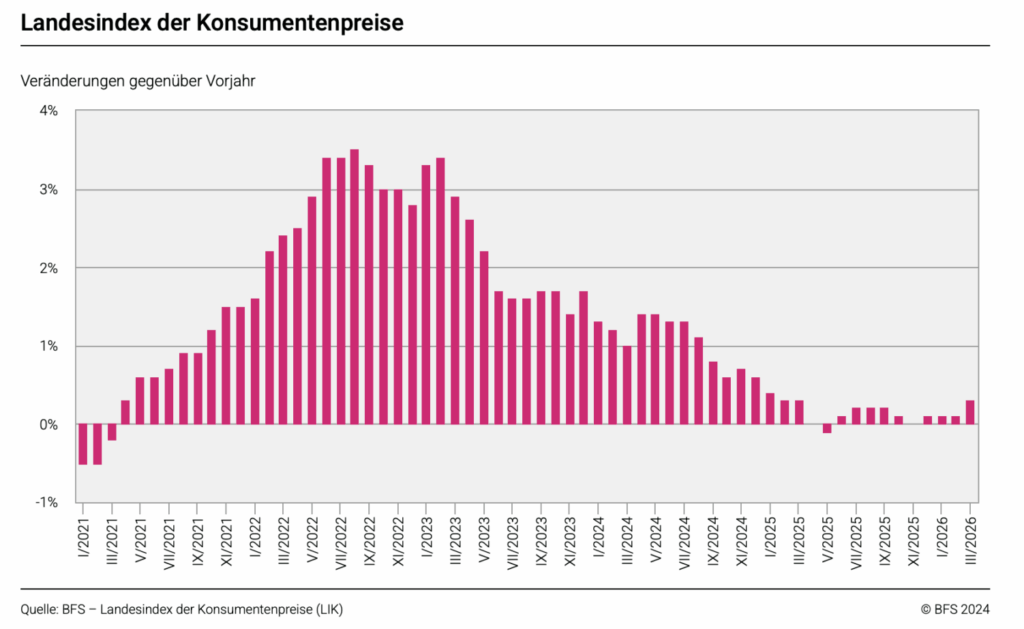
Inflation is picking up in Switzerland. However, the major surge in inflation caused by the U.S.-Israeli war of aggression against Iran is yet to come.
Switzerland has moved away from zero inflation, and the risk of deflation has been averted.
Movement within a month
The National Consumer Price Index (LIK) rose by 0.3 percent in March 2026 compared to the same month last year, as the Federal Statistical Office (FSO) announced today, Maundy Thursday.
Compared to the previous month, the Swiss price level rose by 0.2 percent, the report added.
Higher prices have been observed for heating oil and package tours abroad.
Petroleum products rose in price by 10.6 percent within a month, according to the detailed data.
Prices for energy and fuels rose by 4.4 percent.
Domestic goods became 0.2 percent cheaper. Imported goods, on the other hand, became 1.8 percent more expensive, as the FSO further reported.
Manipulation takes effect
Over the course of a year, however, the trends are different.
Prices for domestic goods rose by 0.5 percent in March compared to March of the previous year.
Goods and services imported from abroad fell in price by 0.3 percent over the course of 12 months.
However, the manipulations by federal statisticians, which muula.ch has disclosed regarding inflation measurements starting in January 2026, are having an effect.
A contrary reality
Prices for alcoholic beverages and tobacco rose by 2.4 percent.
This had been expected, which is why statisticians deliberately increased their weight in the consumer price index, even though fewer and fewer Swiss people are actually consuming alcohol or smoking.
It should be noted that Switzerland faced the risk of falling into deflation over the long term.
And the FSO strategically tweaked their basket of goods, thereby averting this danger.
Inflationary surge still to come
Rent prices rose by 1.4 percent year-over-year in March.
The US-Israeli war of aggression against the Islamic Republic of Iran, on the other hand, has not yet had as strong an impact as it did a month ago.
Prices for petroleum products rose by ‘only’ 5.3 percent compared to March 2025, according to the FSO.
Energy and fuel prices rose by a mere 0.5 percent.
Slow penetration
With heating oil, however, this effect is already more evident. Compared to the previous month, heating oil prices surged by 31.0 percent.
Compared to the same month last year, however, they rose by 21.8 percent.
Slowly but surely, these price increases are also beginning to show up in inflation data.
In the energy sector, prices in Switzerland cannot rise as sharply anyway because they are regulated and can only be adjusted for end consumers once a year.
Curbing sales
Furthermore, if prices continue to skyrocket, the Swiss National Bank (SNB) will have to raise key interest rates to curb inflation.
As is well known, higher interest rates make saving more attractive and reduce consumption. If companies’ sales decline, they must lower their selling prices – that is the mechanism.
In the long term, it remains to be seen whether the manipulations of the LIK will backfire. After all, no one anticipated the war with Iran and therefore did not expect such a sharp rise in prices.
A countervailing effect offers Switzerland some hope. With every geopolitical escalation, the go-to Swiss franc rises, making imports cheaper.
04/02/2026/kut./ena.