
J. Safra Sarasin Bank has not publicly reported any losses in the billions. Yet these big losses do appear in the books for tax purposes.
Anyone who studies the annual financial statements in detail can make some intriguing discoveries.
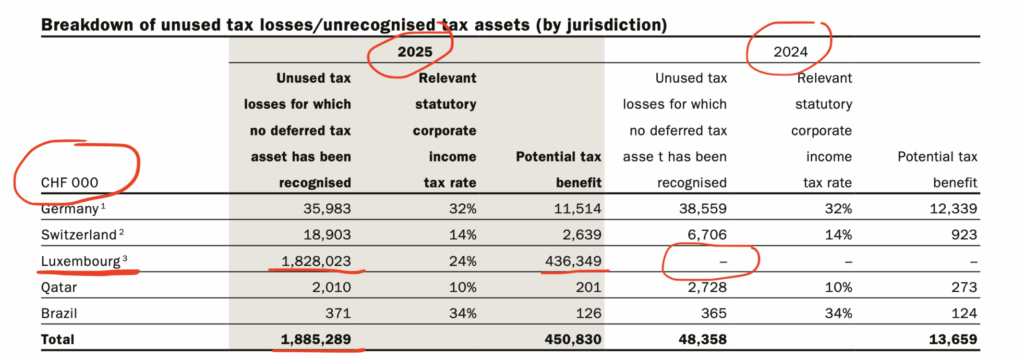
For instance, a strange figure immediately catches the eye of readers of the annual financial statements of the Basel-based bank J. Safra Sarasin.
Half a Billion in Profit
Loss carryforwards in Luxembourg rose from zero to over 1.8 billion Swiss francs.
But how can the bank arrive at such figures when it reports a profit increase of around 4 percent to 522 million Swiss francs for the 2025 fiscal year?
J. Safra Sarasin does not intend to provide any further clarification on its own.
Beyond the information provided in the 2025 annual report, the bank does not wish to comment on the new loss carryforwards amounting to billions.
This was stated by a media spokesperson for the bank in response to a related inquiry from muula.ch. However, these are not typos.
Online Shop Business Flopped
Accounting experts, on the other hand, explained that such loss carryforwards could end up in a company’s books in two ways.
One possibility is that such high losses actually occurred. But losses of that magnitude would certainly have been noticed somewhere; a few liquidations, as reported by the bank, are unlikely to be sufficient to account for them.
However, there is a report from the German newspaper “Handelsblatt” suggesting that J. Safra Sarasin overextended itself with its investment in the online retailer Thrasio.
This involves private-equity deals that ended in disaster because Thrasio filed for bankruptcy protection in the U.S.
Organizational Chart Changed
The bank had informed clients that they would not see a large portion of their capital again, even though three-digit returns within 12 to 18 months had been promised beforehand.
Another indication pointing in this direction is that in 2025, J. Safra Sarasin transferred private-equity investments from its Swiss parent company to its Luxembourg unit.
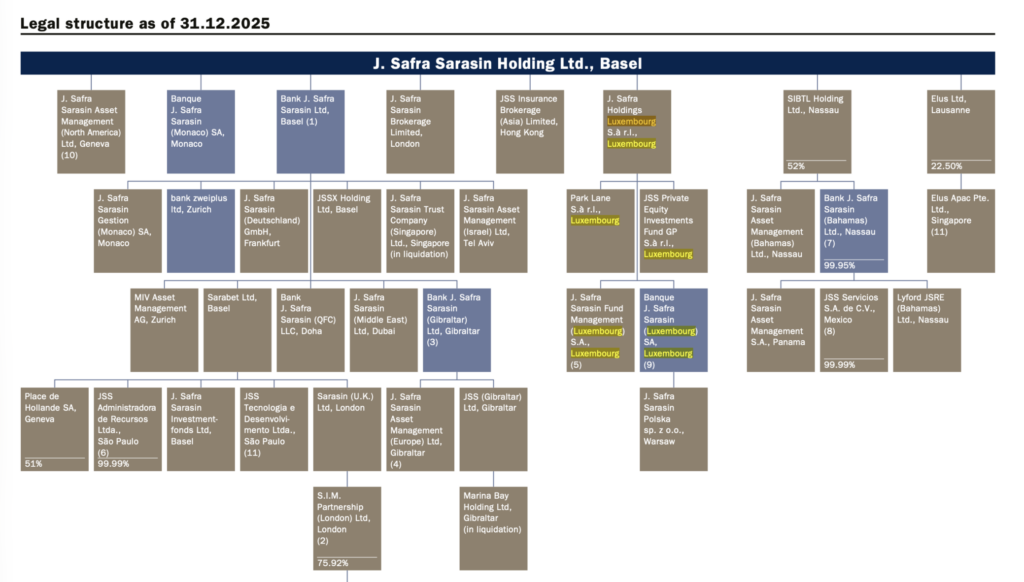
It remains unclear, however, whether the initiator of such investments can claim those tax losses for themselves.
Capitalize on long-standing losses?
But the second option experts suggest would be to acquire a company that has such large tax loss carryforwards.
J. Safra Sarasin acquired a majority stake in the Danish Saxo Bank in 2025. The 70-percent stake had been sold by Zhejiang Gelly Holding of China and Mandatum of Finland.

However, Saxo Bank had been profitable for many years prior, which is why it is highly unlikely that historical losses of such a massive magnitude could still be carried forward.
Yet it would not be impossible, and perhaps that is precisely why it led to the organizational restructuring within the corporate network.
Saving Hundreds of Millions in Taxes
The Basler Banking Group may, however, have acquired another company with such loss carryforwards and will now pay virtually no taxes on profits in the future, provided they are generated in Luxembourg.
According to the company’s own figures, the potential for tax savings amounts to over 436 million Swiss francs.
That could be a fantastic business model, one that would also be of great interest to other companies.
Reading annual financial statements can therefore be quite rewarding. Readers don’t even have to delve too deeply, because the billions immediately catch the eye at J. Safra Sarasin.
June 8, 2026/kut./ena.