
The agricultural cooperative Fenaco saw another decline in revenue and profits in 2025. It appears that this cartel suffer under those who break ranks.
Swiss agricultural cooperative Fenaco is continuing to struggle.
Annual sales of over 8 billion Swiss francs and profits of nearly 130 million Swiss francs are all long gone.
Significant decline
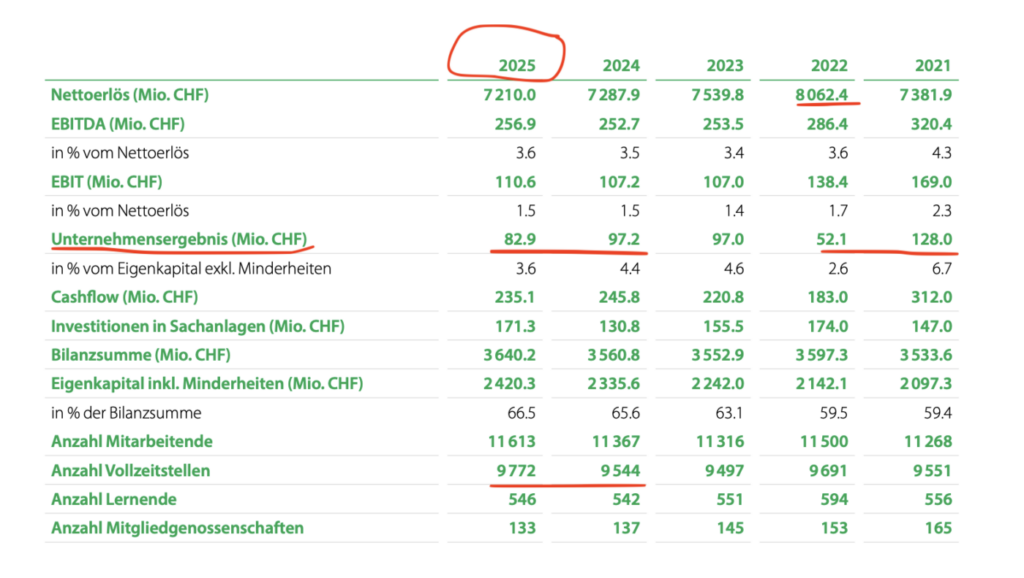
In 2025, revenue fell by 1.1 percent to just 7.2 billion Swiss francs, as Fenaco announced on Tuesday.
Furthermore, profits plummeted by nearly 15 percent to 82.9 million Swiss francs.
In 2022, the company’s earnings had already effectively imploded by around 60 percent to a mere 52 million Swiss francs.
The agricultural cooperative offers Swiss farmers many opportunities to make their purchasing and production more efficient if they join Fenaco.
On the sales side of agricultural products, they often represent a monopoly on supply, which competes with retailers such as Migros, Coop, Denner, Aldi & Co.
Fenaco’s profit, therefore, stems from the market power generated by the merger.
Nearly 20 percent fewer members
Without Fenaco, competition would largely erode this profit. But this would be in the interest of neither the farmers nor Switzerland, as competition is exhausting and leads to losers as well as greater foreign influence.
Yet the farmers’ network is becoming increasingly fragile because, as with all cartels, there are always incentives to break away.
Handling purchasing, production, and sales independently becomes more attractive when the benefits of cooperation fade.
In 2021, Fenaco still had 165 member cooperatives. In the past fiscal year, that number had dropped to just 133, representing a 20 percent decline within those few years.
Costs Spin Out of Control
Why did the downward trend continue in 2025?
According to the 2025 annual report, this was primarily due to lower prices in the international grain trade and the fossil fuel business.
The report went on to state that the main cause of the slump in profits was a lower financial result.
But a look at the annual financial statements reveals that costs are also spiraling out of control in some areas.
“As in previous years, we were only able to partially pass on the high costs in the areas of personnel, infrastructure, energy, and logistics to sales prices,” Fenaco explained regarding these developments.
Of course, partnerships need incentives to keep participants happy. Fenaco still has ample reserves to motivate its partners to join the merger.
A Challenging 2026
As of the end of the year, Fenaco employed 11,613 people. In 2024, the figure had been 11,367. The workforce thus grew by over 2 percent in just one year.
Despite declining sales, the agricultural cooperative even raised the total wage bill for 2026 by 1.0 percent.
The Swiss Farmers’ Association expects 2026 to be a challenging year. According to its outlook, costs for personnel, infrastructure, energy, logistics, and IT have remained high. The agricultural cooperative notes that there are no signs of relief on the cost front.
At some point, the benefits for individual farmers and member cooperatives will become so minimal that it will warrant breaking away. And then the cartel will be history pretty quickly.
May 12, 2026/kut./ena.