Countries include the most diverse items in their defense spending. Switzerland shows how it calculates this and discloses its army’s impressive revenues.
There is no standardized international method for calculating defense spending.
Each country calculates it in the way that suits it best.
Inflating the GDP share
The French and Italians include parts of their paramilitary forces, such as the gendarmerie and the carabinieri, respectively.
Like the French and Italians, the British also include items from other ministries relating to pensions, cyber defense and intelligence services as defense spending, provided they serve some military purposes.
Clearly, the states are pursuing the goal of meeting NATO’s defense spending targets, which are measured as a percentage of each country’s gross domestic product (GDP).
So – it has to look like a lot!
Investments by Armasuisse
The total cost of the Swiss Armed Forces with its militia system amounted to around 8.5 billion Swiss francs in 2023, as announced by the Federal Council in a report shortly before the turn of the year.
The army’s expenditure reported in the 2023 national accounts, which is subject to the debt brake, amounted to around 5.9 billion Swiss francs.
This included operating and investment expenditures, including armament expenditures, as well as transfer expenditures by the Defense Group and the Federal Office for Armament Armasuisse.
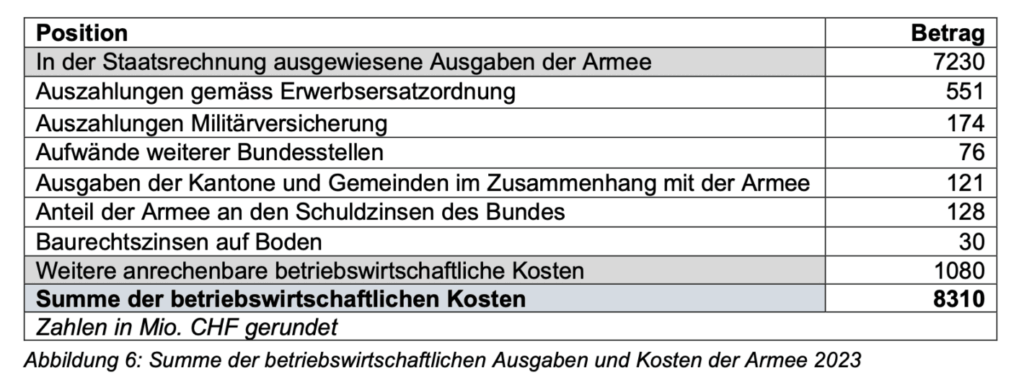
In addition, there were also charges of around 140 million Swiss francs for services provided by other federal agencies to the army. Expenses of 1.17 billion Swiss francs were not subject to the debt brake.
Switzerland added to this 7.23 billion Swiss francs the public sector expenditure that, although not directly related to the army, can be thematically assigned to it.
According to the overall report, this mainly includes compensation for loss of earnings of 551 million Swiss francs and military insurance payments of 174 million Swiss francs.
Salary payments and orientation days
The cantons and municipalities also provided some services to the army, which amounted to around 121 million Swiss francs. These included the organization of orientation days and the maintenance of military infrastructure.
Together with other public expenditure of 76 million Swiss francs and imputed costs of around 158 million Swiss francs, the army’s operating costs amounted to around 8.31 billion Swiss francs.
Added to this were the estimated economic costs of the army, which can be quantified with sufficient justification.
Switzerland included the voluntary continued payment of wages by employers, amounting to 200 million Swiss francs, in this figure.
Confusion about spending targets
Measured against the country’s high GDP, Switzerland’s share of total costs for the army, the Department of Defense (DDPS) and related bodies amounts to 1.06 percent.
This means that the required target of 1.0 percent of GDP for defense has already been achieved.
However, Parliament based this target on those items subject to the debt brake.
The Federal Council stated this figure for 2019 as 0.67 percent of GDP. To this value the increase in army spending then refers.
Earning money through defense
In the report, however, Switzerland also mentions the income it generated.
These include, for example, property rentals of 12 million Swiss francs in 2023. In addition, there were even bequests and donations of around 17 million Swiss francs.
Swiss citizens even donate bequests and land to their country.
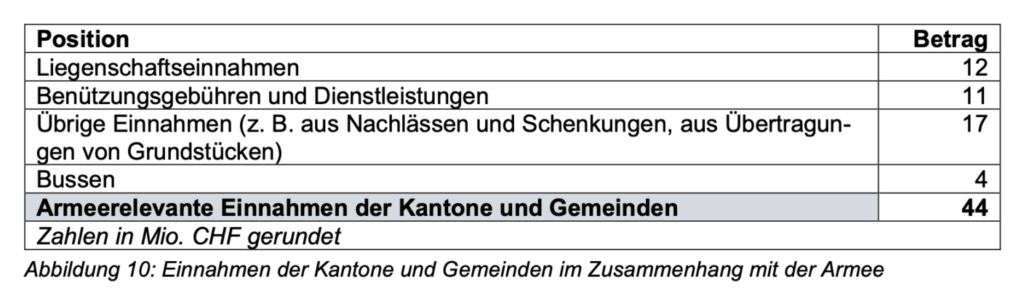
The Swiss defense even imposed fines totaling 4 million Swiss francs, which also had a positive impact on state coffers.
Shopping generates new budget
The calculations even go so far as to suggest that federal procurements, such as the F-35 fighter jets, generate hundreds of millions in new VAT revenue for the federal government elsewhere, as muula.ch has recently reported.
So, the more purchases the country makes, the more the state seems to generate budgets to spend money.
It is therefore probably a good thing that there are no binding international standards for comparisons.
05.01.2026/kut./ena.