
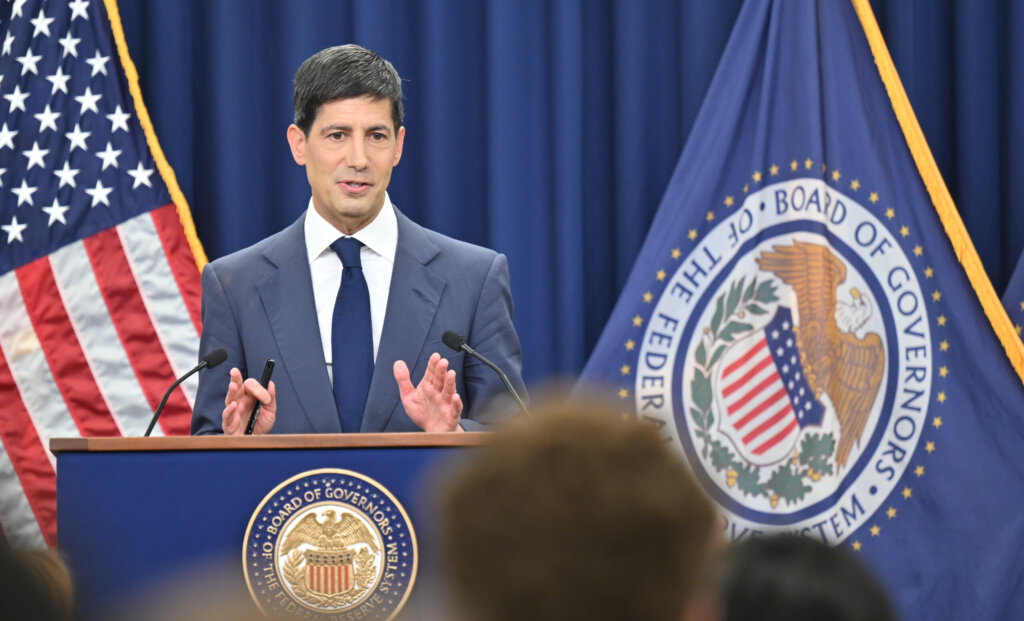
The US Federal Reserve is raising interest rates for the first time since 2023 and risking a dispute with Trump. But also Switzerland is coming under pressure.
Things are going really badly for US President Donald Trump at the moment.
While he fails to find a solution to the war with the Islamic Republic of Iran, his hand-picked new head of the US Federal Reserve, Kevin Warsh, is also stabbing him in the back.
Higher Inflation in Sight
This Wednesday evening, the Federal Reserve Bank Fed increased US key interest rates by 0.25 percentage points from 3.75 to 4.0 percent for the first time since 2023, as the US central bank announced in a short statement.
Trump actually called for a cut in interest rates.
But the money watchdogs are expecting higher inflation of 3.7 percent, especially because of the US-Israeli war of aggression on Iran, which is far from the price stability goal of 2.0 percent.
Trump Hit Below the Belt
With the interest rate increase of 0.25 percent, Warsh wanted to curb inflation, which he now described as “too high.”
This puts him in the boxing ring with Trump, who can no longer harm him after his appointment as Fed Chair in May. The US President had burdened Warsh’s predecessor, Jerome Powell, with all sorts of investigations.
But Powell was not deterred by those attempts at intimidation.
Labor Market On Track
Experts even expect the Fed to raise interest rates again this year.
Inflation is far too high – even in the US Federal Reserve’s projections – and Trump himself is actually to blame.
The second goal of the US central bank, the greatest possible employment, currently plays a minor role because there is virtually full employment in the USA.
US National Debt as a Problem
It is now becoming more expensive for the Trump administration to finance the US national debt, which now totals over 40,000 billion.
But Switzerland also has nothing to laugh about with the US interest rate decision.
On the one hand, Trump will increase the pressure on foreigners to buy more US government bonds, despite the threat of further interest rate increases.
Swiss investors, including the Swiss National Bank SNB, had reduced their positions in this regard, leaving the US administration out in the cold.
End of the Zero Interest
On the other hand, it is becoming increasingly difficult for the Swiss central bank under the leadership of Martin Schlegel to maintain its zero interest rate policy.
Investors in this country borrow money practically for free and can invest it lucratively in the USA or the euro area, which weakens the Swiss franc.
But this means that inflation from abroad is spilling over into Switzerland, which the SNB actually has to take action against.
New Means of Pressure Needed
The Fed interest rate decision does not bode well for the currently hapless Trump.
He now has to think about a strategy to find more government revenue and new investors for as little interest expense as possible.
However, this is unlikely to be such an easy task because the leverage for US punitive tariffs, relief from the US in the Ukraine war, etc. have all been exhausted.
So, the world can now look forward to Trump’s revenge.
September 16, 2026/kut./ena.