
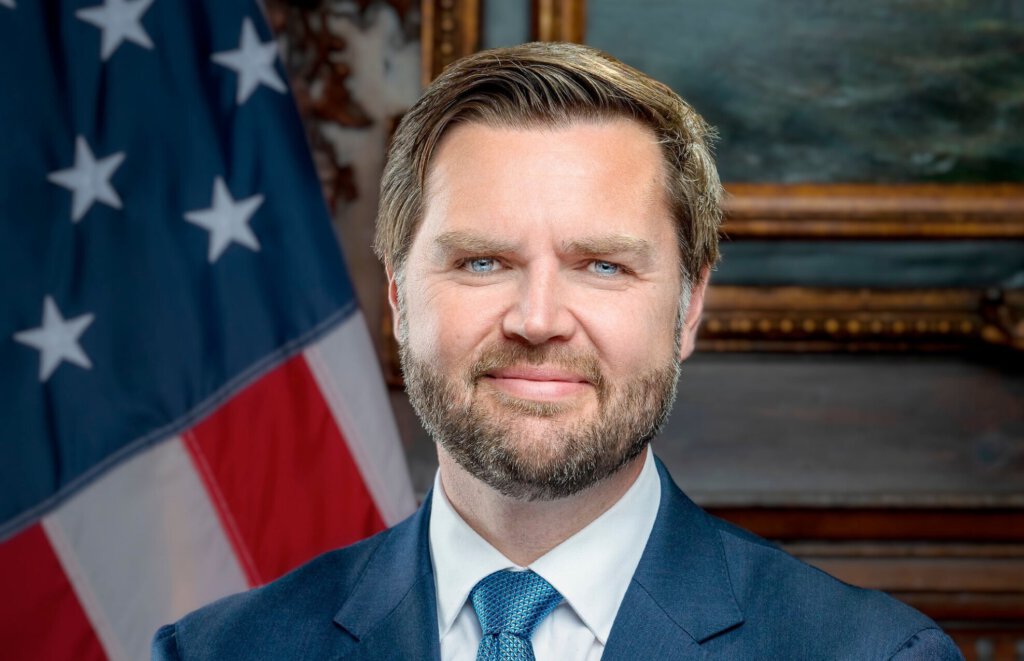
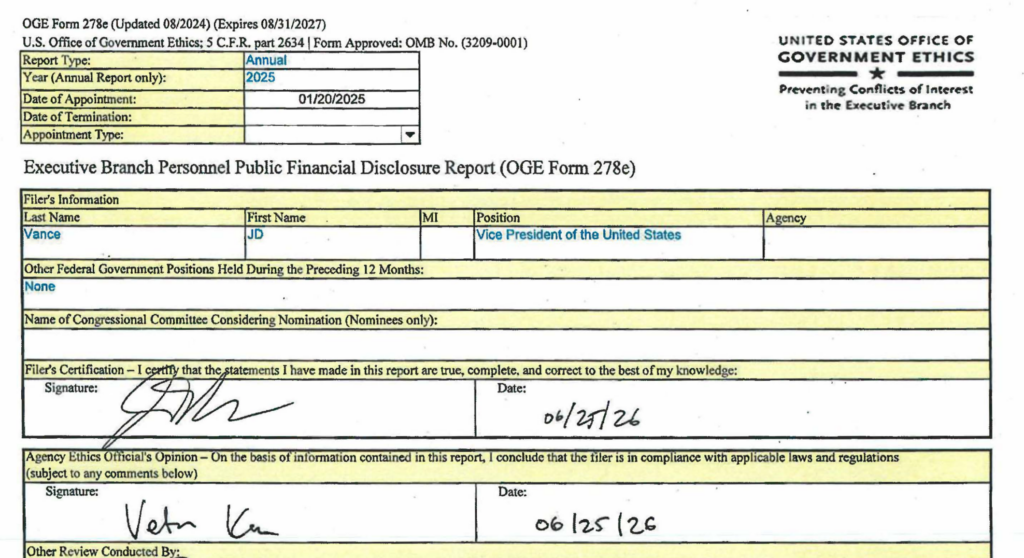
U.S. presidents and vice presidents are required to disclose their finances. But while everyone was up in arms over Trump, it’s worth looking at Vance.
These finance details of U.S. presidents and vice presidents offer a deep glimpse into the character of the individual.
But with U.S. President Donald Trump, the world had to wade through nearly 1,000 pages.
Started with Thiel
While there was a lot of outcry over that, the analysis of U.S. Vice President JD Vance’s annual financial disclosures was largely overlooked.
It’s worth taking a look, however, because others can learn a lot from the lawyer and venture capitalist’s investment strategy.
After graduating, the lawyer eventually joined an investment firm in San Francisco associated with entrepreneur Peter Thiel.
Long-Term Cash Flows
JD Vance was also tasked with focusing on underfunded regions outside the Silicon Valley and New York City tech hubs (“Rise of the Rest”) and, in 2019, founded the venture capital firm Narya Capital himself – a venture that accounts for a large portion of his financial disclosures, spanning just under 17 pages.
While he often receives no payouts from these investments – or less than 201 dollars per year.
But sometimes, years later, hundreds of thousands still flow in as fees – a development strongly reminiscent of ‘deals’ also underscoring his focus on long-term cash flows.
Money First, Work Second
JD Vance publishes books; his most important work, “Hillbilly Elegy,” is an autobiographical account of his family and their economic struggles.
But instead of writing a book first – as any normal author would – and then pitching it to publishers, JD Vance collects substantial advance payments.
Meanwhile, his bestseller, published in 2016 with its film adaptation, are generating substantial income, as can be seen from the financial statements.
Low Fees
Of his four children, three have investments with Vanguard.
The U.S. asset manager, a cooperative, is known for its extremely low fees and, as a conservative institution, for consistently avoiding gold, cryptocurrencies, and the like because they do not generate recurring cash flows.
Over the decades, investors can save a lot of money with low fees thanks to the effects of interest and compound interest.
JD Vance also invests separately in gold and has an account with the cryptocurrency exchange Coinbase.
He has invested up to 500,000 dollars in Bitcoin, but has not generated any returns from it in 2025.
Don’t Pick Individual Stocks
Bonds, on the other hand, provide the U.S. vice president with a few distributions through an iShares fund, as do ETFs tracking the S&P 500 – an approach that could be described as ‘traditional’.
Exchange-traded funds (ETFs), which are also known for their low fees, are favored by the U.S. politician when it comes to the Dow Jones Industrial Average.
He is also invested heavily in the Invesco QQQ Trust ETF, which tracks the Nasdaq 100 Index – featuring Apple, Microsoft, Nvidia, and Amazon – and also pays out dividends that are worthwhile for JD Vance.
The American investment guru avoids “stock picking,” or investing in individual stocks.
Balancing Growth and Stability
Although he has several tax-advantaged retirement accounts (IRAs), he does not use them.
Apparently, the U.S. vice president wants to maintain flexibility in his investment strategy.
It is often very difficult to withdraw money from retirement accounts.
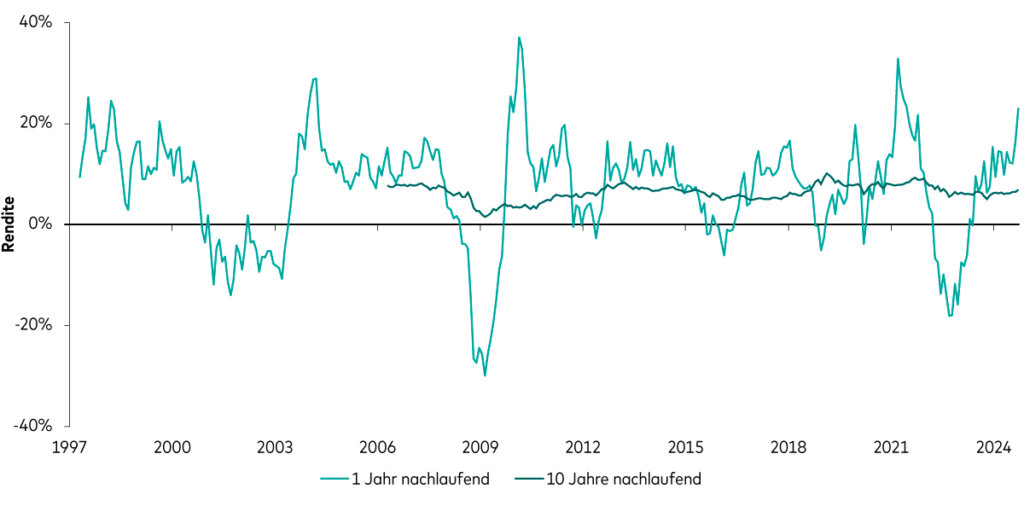
Over the past few decades, a 60-40 investment strategy has generally proven effective for building wealth, as calculated by U.S. asset manager Vanguard.
This strategy allocates 60 percent to stocks to generate growth and 40 percent of assets to bonds to ensure stability and generate regular income.
Real Estate through a Company
Since much of the information on the form is provided only as ranges, outsiders cannot precisely determine the investment strategy.
However, a 60 percent allocation to stocks is certainly a plausible estimate.
Real estate is a must in his portfolio; in Washington, the U.S. Vice President even generates rental income from it, which in turn demonstrates cash flow.
In Cincinnati, Ohio, a historic single-family home – which Vance holds through 1858 Taft Road LLC – is apparently for sale. The return on investment achieved looks impressive in any case.
Flexible Million-Dollar Loan
Last but not least, it’s worth taking a look at the financing side.
In 2014, JD Vance took out a 30-year mortgage at 3.875 percent from Navy Federal Credit Union.
With such a long term, those are likely to be unbeatable terms.
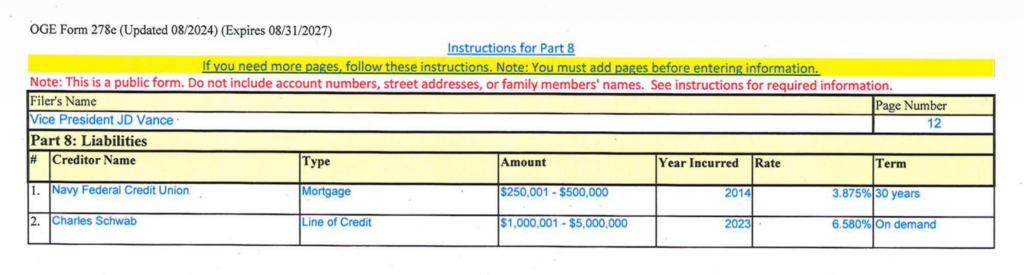
At Charles Schwab, the U.S. vice president secured a multi-million-dollar line of credit in 2023 at 6.58 percent, which he can draw on as needed.
Sound Principles for Investing
Low fees, a concise overview on just a few pages, a long-term focus, good diversification across all asset classes, combined with affordable financing. These are the key principles of attorney, venture capitalist, author, and U.S. Vice President JD Vance.
That’s quite impressive. And many people around the world can take a cue from this when it comes to their own investment strategies.
August 11th, 2026/kut./ena.