All companies try to generate high sales. But the figures do not always reflect actual sales, as some examples show.
The offer to the editorial team of our business news portal sounded tempting.
Five business licenses for the latest version of ChatGPT would be offered free of charge, according to an email.
Official company invoice
This represents a gift of 170 Swiss francs for one month, as the license price for OpenAI’s artificial intelligence costs 34 Swiss francs per workstation.
But if you take a closer look, you can discover many interesting details. The company sends an official invoice via its Irish subsidiary, OpenAI Ireland Limited.
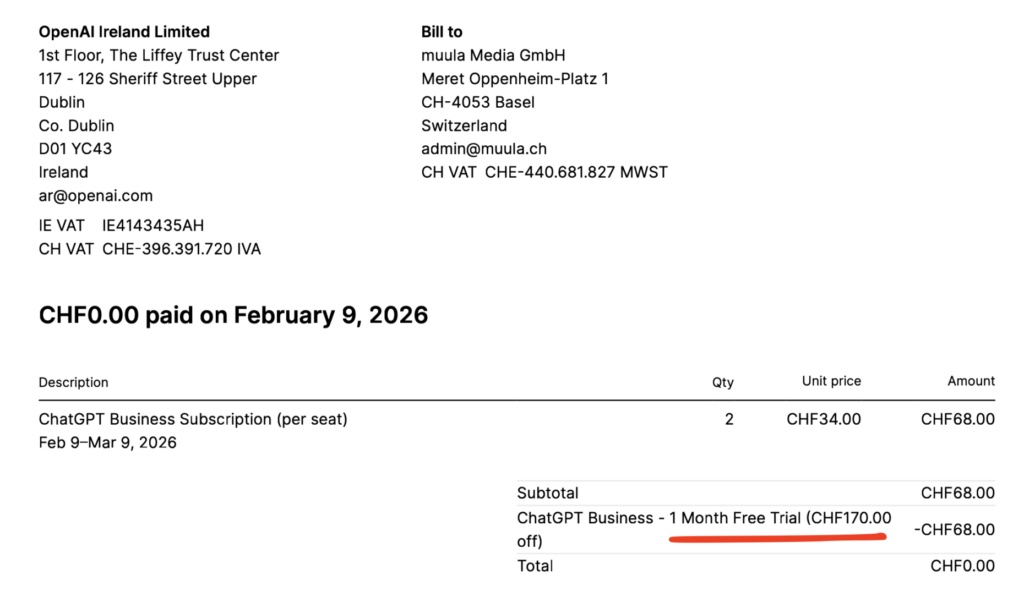
Although the amount is 0.00 Swiss francs, the gross sales revenue for five licenses still amounts to 170 Swiss francs.
A voucher code is then applied, which represents an expense for the company in this form, because otherwise the customer would actually have to pay.
Millions possible
If 1,000 companies around the world were to accept the ChatGPT offer, OpenAI would generate 170,000 Swiss francs in revenue and 170,000 Swiss francs in marketing expenses in just one month.
With 100,000 new business customers, that would already be 17 million Swiss francs. After all, invoicing is linked to accounting.
Difficult cancellation
Of course, the private company hopes that some users will enjoy ChatGPT and not cancel their trial subscription.
This is not so easy anyway. Not even the AI itself correctly explains how the “free trial” can be terminated.
Many trial subscriptions may eventually turn into real sales in the long term. And if the company goes public, many customers and “sales” are always important.
Trick at Coop
But it’s not just artificial intelligence companies that use such free products to embellish their figures.
For example, anyone who receives a voucher for a product sample from the import perfumery that belongs to the retailer Coop can also discover something exciting on their receipts.
Coop enters a whopping 50 Swiss francs in sales for a mini Biotherm shaving cream.

Further “test purchases” of fragrance samples from muula.ch cost 23.30 Swiss francs or 8.90 Swiss francs.
With just three free products, the Coop Group generates over 80 Swiss francs in cash register sales.
To ensure that customers do not have to pay anything, a “gift voucher” is required, which is essentially included in the marketing costs.
Creative accounting
The same applies to products in the children’s stamp collections in Coop supermarkets themselves.
The retailer enters 19.90 Swiss francs or 24.90 Swiss francs in gross sales into the cash registers and then deducts the amounts for the free products via vouchers or “trophy” bonuses, for example.
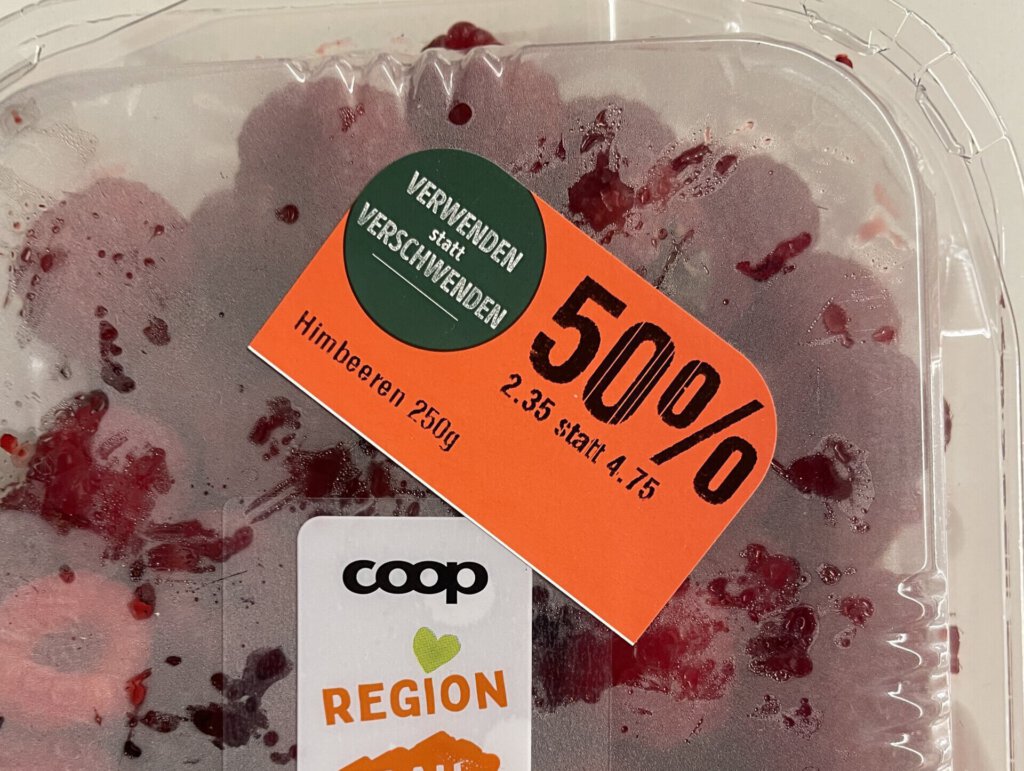

If thousands of people take advantage of such offers, the retailer generates millions in fictitious bookings, which make the Coop Group look bigger.
In the neck-and-neck race with its competitor Migros, the fight is fierce.
Even with special offers, Coop increases the original sales price and books more at the checkout, as the example in the images above illustrates. A thousand such items generate 1,000 new Swiss francs in sales.
Free even with newspapers
The media could also do all these things and offer customers free monthly subscriptions.
Our business news portal muula.ch would probably already be a million-dollar corporation – thousands pay nothing each month, but a lot of money ends up on the balance sheet, which ultimately “comes in” as revenue and goes right back out as marketing expenses.
Transitory items make companies bigger. There are virtually no limits to creativity in this area.
Anyone who understands accounting can get creative, just like ChatGPT, Coop & Co.
February 22, 2026/kut./ena.